
I was trained to pull answers out of medical data.
These days I mostly pull permission slips.
I work as a data scientist in the data department of a medical institute. For years the job was what the title promised: take messy clinical data, build models, find the thing nobody saw, hand it to someone who could act on it.
Then the governance wave arrived, and the data started disappearing behind doors.
I want to start with what the governance side gets right, because they get a lot right — and because I’ve watched researchers pretend otherwise.
Our privacy law, PDPA, exists for the same reason HIPAA exists in the US: patient data is the most intimate data there is. Protecting it is not bureaucracy. It’s the reason patients tell us the truth.
The unglamorous basics matter too. Remove the account the day the employee resigns. Enforce real password policy. Make researchers state what data they need and why, in front of an IRB, and limit the dataset to the question — at least where the question can be stated in advance.
And some of the “no”s I’ve witnessed were correct. I’ve seen data requests arrive with no harm model, no minimization plan, no named person willing to carry accountability for the result. A “no” in that situation isn’t obstruction. It’s the only responsible answer — and the researchers grumbling about it, sometimes including me, needed to write better requests.
So no, I’m not against governance.
I’m against fear wearing governance’s clothes.
Here’s how you tell the difference.
“No, because PDPA.”
It’s a complete argument now. A conversation-ending spell. Swap in HIPAA or GDPR and you’ve heard it too.
And here’s what most people casting it don’t know: PDPA was written with research pathways in it. The drafters — who modeled it closely on GDPR, research carve-outs and all — anticipated scientific research and drew lawful routes for it on paper, with safeguards attached — routes still being tested in practice, but routes.
The law was designed as a gate. We use it as a wall.
To be fair, the gate is harder to open than it should be. The research provisions exist, but the implementing guidance hasn’t caught up, so institutions are left interpreting the law in real time. Caution in that situation isn’t crazy.
But there’s a test, and it’s simple. A real governance decision can be written down: this regulation, this section, this specific risk, this alternative considered — signed. Fear can’t survive being written down. “No, because PDPA” almost never comes with a memo.
And the fear is rational, which is what makes it so hard to fight. A “no” costs nothing anyone can see. A “yes” has your signature on it. We built a system where blocking ten good studies carries no penalty and approving one bad one can end a career.
Then we act surprised that everything stops.
And part of this isn’t temperament at all. It’s design. The law gives the person who signs a good-faith “yes” almost no protection if the call later turns out wrong. Until that changes, calling them cowards is cheap. Build the safe harbor, and watch how much of the “fear” evaporates on its own. Build the protection first. Then ask people to be brave.
Now follow a single patient through our building — under the new ownership policy, at least the way we’ve implemented it.
She visits five departments. Cardiology, radiology, the lab, pharmacy, the ward. Her record — one clinical story — is now five territories, each with its own owner, each owner accountable for his own risk and rewarded for nothing else.
Watch what that does to the youngest people in the building. A medical student gets her protocol through the ethics committee — months of work in itself, and fair enough; that review exists for good reasons. Then she discovers the EC approval was the easy part. The data request enters a second queue, three months and counting, and nobody can tell her three simple things: whether she’ll get the data at all, who has the authority to say yes, and who actually owns the records she needs. The request crawls from desk to desk collecting signatures like a passport collecting stamps — each signer confident that someone earlier in the chain must have read the protocol properly. The coordinator chasing those signatures holds the whole chain together with reminder emails and memory, and gets thanked by nobody. The student will probably graduate before the dataset arrives. And the lesson she actually learns — the one we are really teaching — is that this institution makes research difficult. She’ll remember it when she decides where to build her career.
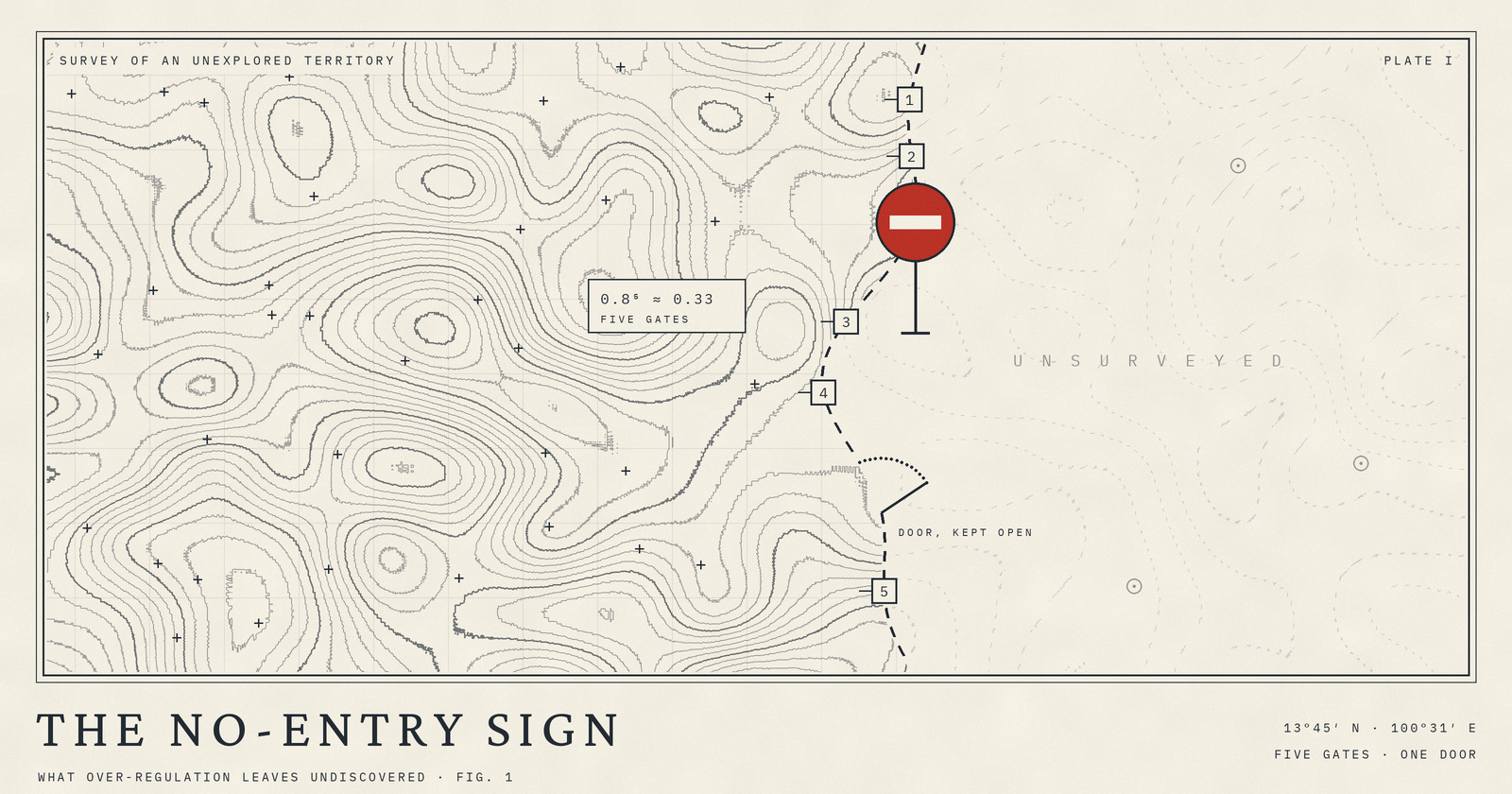
A researcher who wants to study her whole journey needs five permissions. Say each owner approves four out of five reasonable requests. Multiply 0.8 by itself five times and you land at about 33 percent. The number is illustrative — real approvals aren’t independent coin flips, and a project with strong backing probably fares better. But the direction is the point. Every gate you add is a multiplication, and multiplication is merciless. And before anyone defends the gates: the same request used to need one signature, from one steward, under the same law. None of this is an argument against review itself. It’s an argument against uncoordinated review — five gates pretending to be one.
I can hear one objection, and it deserves an answer: maybe she wants her record separated. Maybe she’d rather her psychiatric notes never sit beside her cardiology file. That’s legitimate — and it’s an argument for patient-controlled access, which I’d welcome tomorrow. It is not what we built. We built owner-controlled access. She has no more say than before; she just has five custodians who can’t talk to each other.
And underneath all of it sits a question nobody will answer out loud: whose data is this, actually? The hospital’s? The patient’s? The payer who reimbursed the treatment? The department head who guards the server? The doctor who typed the note at 2 a.m.? I have heard all five claimed — politely, firmly — in the same meeting. A system that can’t answer the ownership question doesn’t distribute ownership. It distributes vetoes. It also quietly breaks security, because you can’t set access controls on data whose legitimate owner is still being argued about.
My manager — a governance man through and through — has a phrase for all this: “Stop patching. Rebuild the house from the ground up.”
As an engineering instinct, I respect it. Patched systems do rot.
But a hospital is not a software migration, and nobody has answered the question of where the research lives while the house is down. The external partnerships we spent years building — with universities, with industry, with a clinical-research partner that waited months for a dataset that never came — are quietly dying in the queue.
Here’s how it goes. If you work in this field, you’ve seen some version of it.
A team proposes a deterioration model — the kind that flags a patient hours before the crash team gets called. The data exists. The methods are boring and proven. The permissions take eighteen months and span two committee restructures. By the time the last signature lands, the EHR has been upgraded and the feature pipeline no longer matches. The lead, tired of waiting, has left for a startup that promised her data on day one. The model is never deployed.
And that’s the version where the project dies cleanly. The other version is worse: the dataset finally arrives — month eleven — with the date columns stripped, because somewhere in the chain a careful person read “de-identify” as “remove time itself,” and the survival analysis the whole protocol was built around is no longer possible. A slow yes is not the same as a yes.
And then — nothing. No alarm. No inquiry. The patients it might have flagged will never know, because you can’t miss a warning you never got.
A breach generates an incident report, an investigation, headlines. An unbuilt model generates silence. There is no incident report for the discovery that didn’t happen — and an institution that only counts one kind of failure will slowly optimize itself into exactly the corner we’re standing in.
And research is the lucky case, because research at least has a lane — IRB, ethics committee, a recognized path, however slow. The innovation work has none. The bed-management dashboard. The smart-hospital pilot. The app that shortens a registration queue. The operational analytics the strategy team keeps asking for. None of it publishes, so none of it fits the research template — and we already have a policy that covers it: blind the PHI before use. Sensible. Sufficient, even. But what these projects actually get is a “no” without a glance — not a no after reading, a no instead of reading. That’s the cleanest definition of over-regulation I can offer: when rejecting a request takes less effort than understanding it would have.
Nobody is winning here. The governance team didn’t sign up to run the Office of No; they wanted to build systems people trust, and instead they absorb blame for every stalled project. Researchers watch their skills go stale in a queue. The institute trains people and then hands them reasons to leave. And the patients — the people all of this is for — lose quietly, in the one column nobody audits.
Data locked away by fear — not by law, not by principle, by fear — protects no one.
It just expires.
If this were only my institute, it would be a management problem. It isn’t. The same fight — explorers versus fence-builders — is running at every scale right now, and the most credible people in it refuse to pick a side.
When California tried to pass SB-1047, its sweeping AI safety bill, the loudest objections came from the field’s own builders. Andrew Ng argued it regulated the technology instead of the application. Fei-Fei Li — nobody’s accelerationist — warned it would land hardest on academia and small labs, the players least able to afford compliance. The governor vetoed it. Everyone in that fight had skin in the game, which is exactly why it was worth watching.
And I keep turning over a recent essay by Dario Amodei, who runs Anthropic, the most safety-obsessed of the big AI labs. He asked governments to step in: mandatory testing for frontier models, with legal power to block dangerous deployments. And in the same essay, he argued the FDA should move faster — accept AI-based evidence, clear the path for AI-discovered drugs.
More regulation at the frontier. Less friction in the clinic. From the man whose company exists because of AI risk.
Different territories need different rules. A frontier model and a hospital ward don’t share a risk profile, and a policy that can’t tell them apart isn’t cautious — it’s blind.
Even cybersecurity, the field governance leans on hardest, only exists because someone explores. Every defense you trust came from a red team walking into the dark first. CISOs authorize controlled break-ins against systems that have never been breached. That’s what mature risk management looks like. Not a wall — an expedition, with instruments.
In 1865, the British Parliament passed the Locomotive Act — remembered as the Red Flag Act. Self-propelled vehicles were limited to four miles per hour in the country, two in town, with a man walking ahead carrying a red flag.
The law wasn’t wrong in principle. Cars really would go on to kill people — far more than Parliament feared. It was wrong in method: calibrated by imagination instead of evidence, then left on the books for thirty-one years while the automobile industry grew up somewhere else.
Aviation went the other way. Flying didn’t become the safest form of transport because anyone banned it. It became safe because every crash was investigated — exhaustively, publicly, blamelessly — and every rule in the book traces back to a failure somebody studied.
Rules from evidence compound into safety. Rules from imagination mostly tell you what the writers were afraid of that year.
You cannot regulate what you have never observed. You can only forbid it.
So what would I actually do? Three things. None of them need new technology.
First, govern uses, not data. The same dataset that trains a sepsis model could, in other hands, feed a marketing list. Those are not the same act, and a policy that can’t distinguish them isn’t a policy — it’s a tarp thrown over the whole field. Write rules about what may be done, by whom, audited how. Not blanket rules about whether data may move at all. I know use-based rules have failed in places — purposes creep, definitions slip — which is exactly why the audit matters more than the rulebook, and why some of this needs the law itself to grow up, since most frameworks still think in data categories rather than uses.
Second, make every decision a document — the “no”s and the “yes”es alike. Which regulation, which section, what specific risk, what would change the answer — and a name. Not a department. A name. Departments can’t be questioned; people can. A written “yes” protects the person who signed it; a written “no” gives the requester something to appeal — and the appeal needs a clock on it, a real process anyone can use, not a favor that depends on knowing the right vice director. Committees can write hollow memos too, I know. But a hollow memo can at least be challenged. Silence can’t.
Third, walk first, fence later. Small, contained pilots — under ethics review scoped to the pilot, not informal experiments. De-identified cohorts, knowing that de-identification is probabilistic rather than absolute, especially for rare conditions, and saying so out loud. Federated queries that move questions to the data instead of data to questions — which sounds elegant in a slide deck and is, in practice, expensive and slow to harmonize, and worth it twice over, because data that never leaves home is also data that can’t be left on a train. Audit logs on everything.
And patients in the room. On the committees, not just in the consent forms. Ask the woman with five custodians what she’d actually allow her record to be used for. I suspect her answer would be more generous than our policies — and more specific.
Pilots generate the evidence that guidance needs. That’s how a law’s research pathway stops being theoretical.
Researchers accept the instruments — and owe the system complete requests in return: a harm model, a minimization plan, a name of their own on the line. Governance accepts the walking. Neither side gets to freeze the other.
I’ll admit what I don’t know: where the line is. There are datasets I wouldn’t touch with any safeguard in place, and there were days I argued for access I’m now glad I didn’t get. Anyone in this field who claims certainty about the line is selling something.
But I know what a no-entry sign in front of unexplored territory does. It doesn’t make the cliffs disappear, and it doesn’t make the cures inside any less real. It just guarantees that someone else draws the map — and that we meet the cliffs and the cures unprepared, later, on their terms.
My manager might even be right about the house. Some of it does need rebuilding from the ground up.
I’d just like us to keep one door open while we do.